In Which Test Tube(S) Did Protein Digestion Occur (Activity 4)? How Do You Know?
Chapter xv. Brute Nutrition and the Digestive Organisation
15.3 Digestive Arrangement Processes
Learning Objectives
Past the end of this section, you lot will exist able to:
- Describe the process of digestion
- Detail the steps involved in digestion and assimilation
- Define emptying
- Explain the role of both the modest and large intestines in absorption
Obtaining nutrition and energy from nutrient is a multi-step process. For true animals, the first stride is ingestion, the act of taking in food. This is followed by digestion, absorption, and elimination. In the post-obit sections, each of these steps will be discussed in detail.
Ingestion
The big molecules found in intact food cannot pass through the jail cell membranes. Nutrient needs to be cleaved into smaller particles so that animals can harness the nutrients and organic molecules. The first footstep in this process is ingestion. Ingestion is the procedure of taking in food through the oral cavity. In vertebrates, the teeth, saliva, and tongue play of import roles in mastication (preparing the food into bolus). While the food is being mechanically broken down, the enzymes in saliva begin to chemically process the nutrient as well. The combined activeness of these processes modifies the nutrient from large particles to a soft mass that tin can exist swallowed and tin can travel the length of the esophagus.
Digestion and Absorption
Digestion is the mechanical and chemical pause down of food into minor organic fragments. Information technology is important to break down macromolecules into smaller fragments that are of suitable size for absorption across the digestive epithelium. Large, complex molecules of proteins, polysaccharides, and lipids must exist reduced to simpler particles such as simple sugar before they can be absorbed by the digestive epithelial cells. Different organs play specific roles in the digestive process. The animal diet needs carbohydrates, protein, and fat, as well as vitamins and inorganic components for nutritional rest. How each of these components is digested is discussed in the following sections.
Carbohydrates
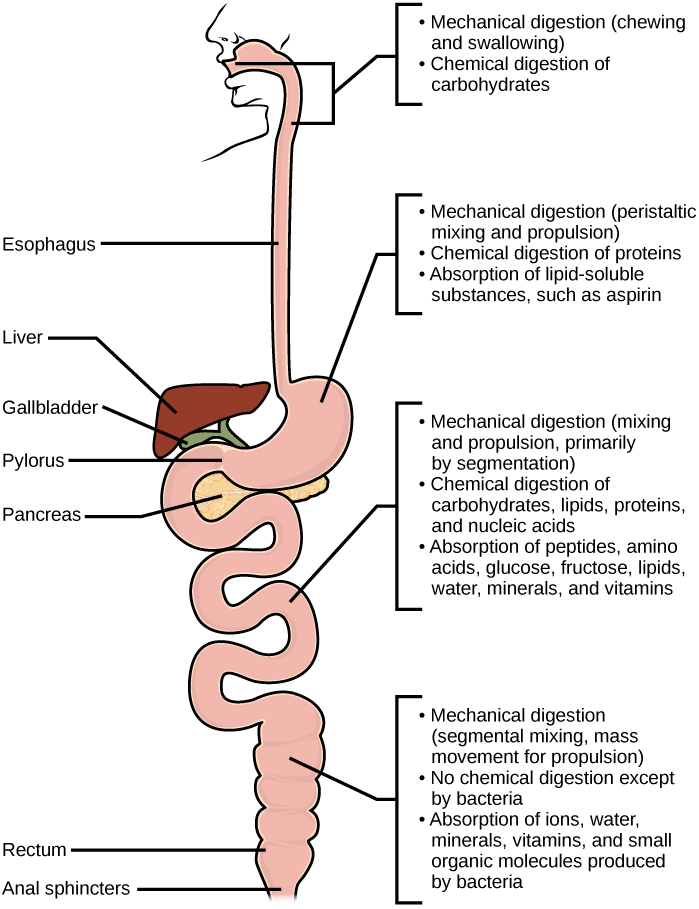
The digestion of carbohydrates begins in the oral fissure. The salivary enzyme amylase begins the breakup of food starches into maltose, a disaccharide. As the bolus of nutrient travels through the esophagus to the stomach, no meaning digestion of carbohydrates takes identify. The esophagus produces no digestive enzymes but does produce mucous for lubrication. The acidic environment in the stomach stops the action of the amylase enzyme.
The next step of saccharide digestion takes place in the duodenum. Recollect that the chyme from the stomach enters the duodenum and mixes with the digestive secretion from the pancreas, liver, and gallbladder. Pancreatic juices likewise comprise amylase, which continues the breakdown of starch and glycogen into maltose, a disaccharide. The disaccharides are cleaved down into monosaccharides by enzymes called maltases
, sucrases, and lactases, which are likewise present in the brush border of the small intestinal wall. Maltase breaks downwards maltose into glucose. Other disaccharides, such as sucrose and lactose are cleaved down by sucrase and lactase, respectively. Sucrase breaks downwardly sucrose (or "tabular array sugar") into glucose and fructose, and lactase breaks down lactose (or "milk sugar") into glucose and galactose. The monosaccharides (glucose) thus produced are absorbed and and so can exist used in metabolic pathways to harness free energy. The monosaccharides are transported across the intestinal epithelium into the bloodstream to exist transported to the dissimilar cells in the body. The steps in carbohydrate digestion are summarized in Figure 15.16 and Table xv.5.
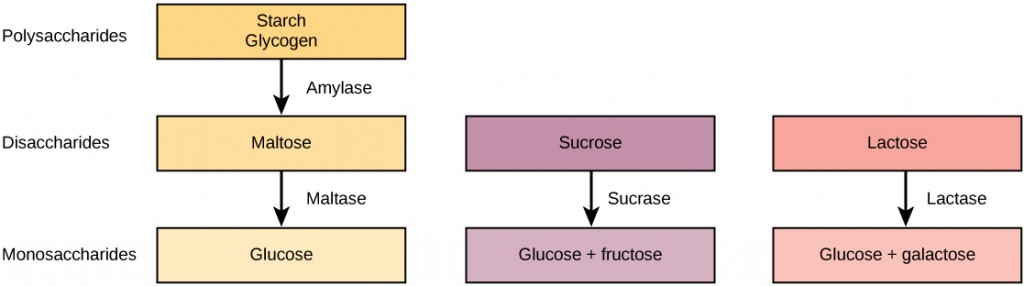
| Enzyme | Produced Past | Site of Activity | Substrate Acting On | End Products |
|---|---|---|---|---|
| Salivary amylase | Salivary glands | Mouth | Polysaccharides (Starch) | Disaccharides (maltose), oligosaccharides |
| Pancreatic amylase | Pancreas | Pocket-size intestine | Polysaccharides (starch) | Disaccharides (maltose), monosaccharides |
| Oligosaccharidases | Lining of the intestine; castor border membrane | Small intestine | Disaccharides | Monosaccharides (east.g., glucose, fructose, galactose) |
Protein
A big part of poly peptide digestion takes identify in the tum. The enzyme pepsin plays an of import role in the digestion of proteins by breaking downward the intact poly peptide to peptides, which are short chains of four to nine amino acids. In the duodenum, other enzymes— trypsin, elastase, and chymotrypsin—act on the peptides reducing them to smaller peptides. Trypsin elastase, carboxypeptidase, and chymotrypsin are produced by the pancreas and released into the duodenum where they human activity on the chyme. Further breakdown of peptides to single amino acids is aided by enzymes called peptidases (those that break down peptides). Specifically, carboxypeptidase, dipeptidase, and aminopeptidase play important roles in reducing the peptides to free amino acids. The amino acids are absorbed into the bloodstream through the modest intestines. The steps in protein digestion are summarized in Figure 15.17 and Table fifteen.6.
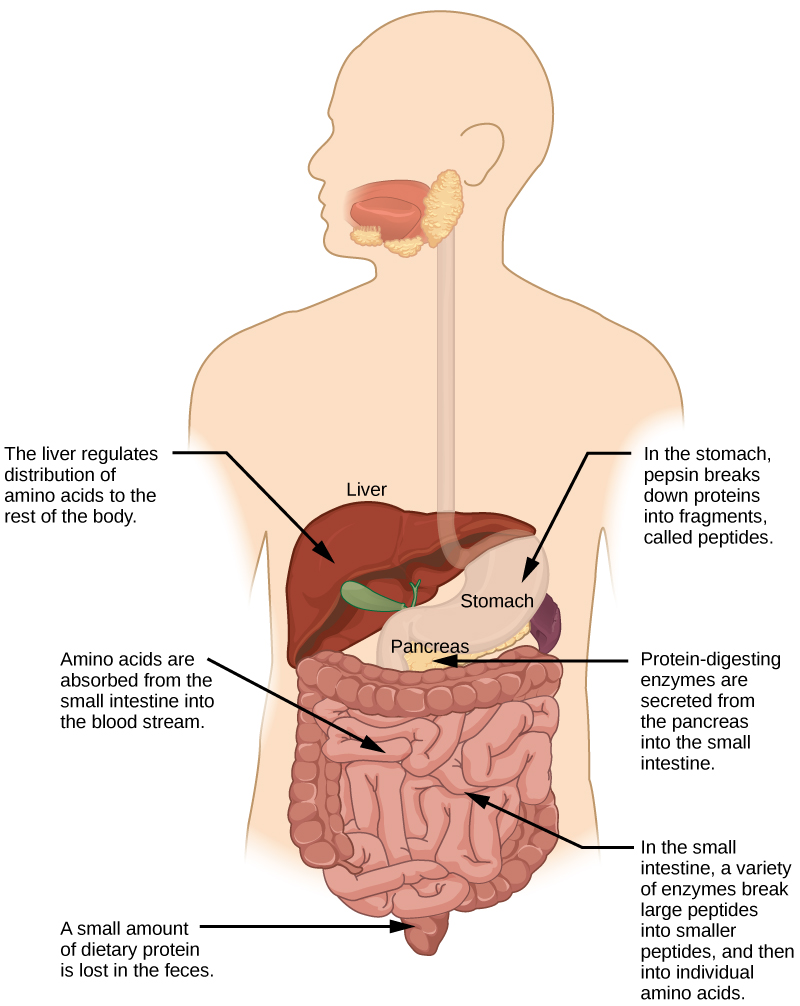
Protein digestion is a multistep process that begins in the stomach and continues through the intestines.
| Enzyme | Produced By | Site of Action | Substrate Acting On | End Products |
|---|---|---|---|---|
| Pepsin | Breadbasket principal cells | Tum | Proteins | Peptides |
| Pancreas | Pocket-size intestine | Proteins | Peptides |
| Carboxypeptidase | Pancreas | Small intestine | Peptides | Amino acids and peptides |
| Lining of intestine | Minor intestine | Peptides | Amino acids |
Lipids
Lipid digestion begins in the tum with the aid of lingual lipase and gastric lipase. However, the bulk of lipid digestion occurs in the small intestine due to pancreatic lipase. When chyme enters the duodenum, the hormonal responses trigger the release of bile, which is produced in the liver and stored in the gallbladder. Bile aids in the digestion of lipids, primarily triglycerides by emulsification. Emulsification is a process in which large lipid globules are broken down into several small lipid globules. These small globules are more widely distributed in the chyme rather than forming large aggregates. Lipids are hydrophobic substances: in the presence of water, they will amass to class globules to minimize exposure to water. Bile contains bile salts, which are amphipathic, meaning they contain hydrophobic and hydrophilic parts. Thus, the bile salts hydrophilic side tin can interface with water on one side and the hydrophobic side interfaces with lipids on the other. By doing so, bile salts emulsify big lipid globules into pocket-sized lipid globules.
Why is emulsification of import for digestion of lipids? Pancreatic juices contain enzymes called lipases (enzymes that suspension downward lipids). If the lipid in the chyme aggregates into large globules, very little surface area of the lipids is available for the lipases to human activity on, leaving lipid digestion incomplete. Past forming an emulsion, bile salts increment the available surface area of the lipids many fold. The pancreatic lipases can so human activity on the lipids more efficiently and assimilate them, equally detailed in Figure 15.xviii. Lipases break down the lipids into fatty acids and glycerides. These molecules tin can laissez passer through the plasma membrane of the jail cell and enter the epithelial cells of the abdominal lining. The bile salts surroundings long-chain fatty acids and monoglycerides forming tiny spheres called micelles. The micelles move into the castor border of the pocket-sized intestine absorptive cells where the long-concatenation fat acids and monoglycerides diffuse out of the micelles into the absorbent cells leaving the micelles behind in the chyme. The long-chain fat acids and monoglycerides recombine in the absorptive cells to form triglycerides, which aggregate into globules and become coated with proteins. These large spheres are called chylomicrons. Chylomicrons contain triglycerides, cholesterol, and other lipids and accept proteins on their surface. The surface is also composed of the hydrophilic phosphate "heads" of phospholipids. Together, they enable the chylomicron to move in an aqueous environs without exposing the lipids to water. Chylomicrons leave the absorbent cells via exocytosis. Chylomicrons enter the lymphatic vessels, and then enter the blood in the subclavian vein.
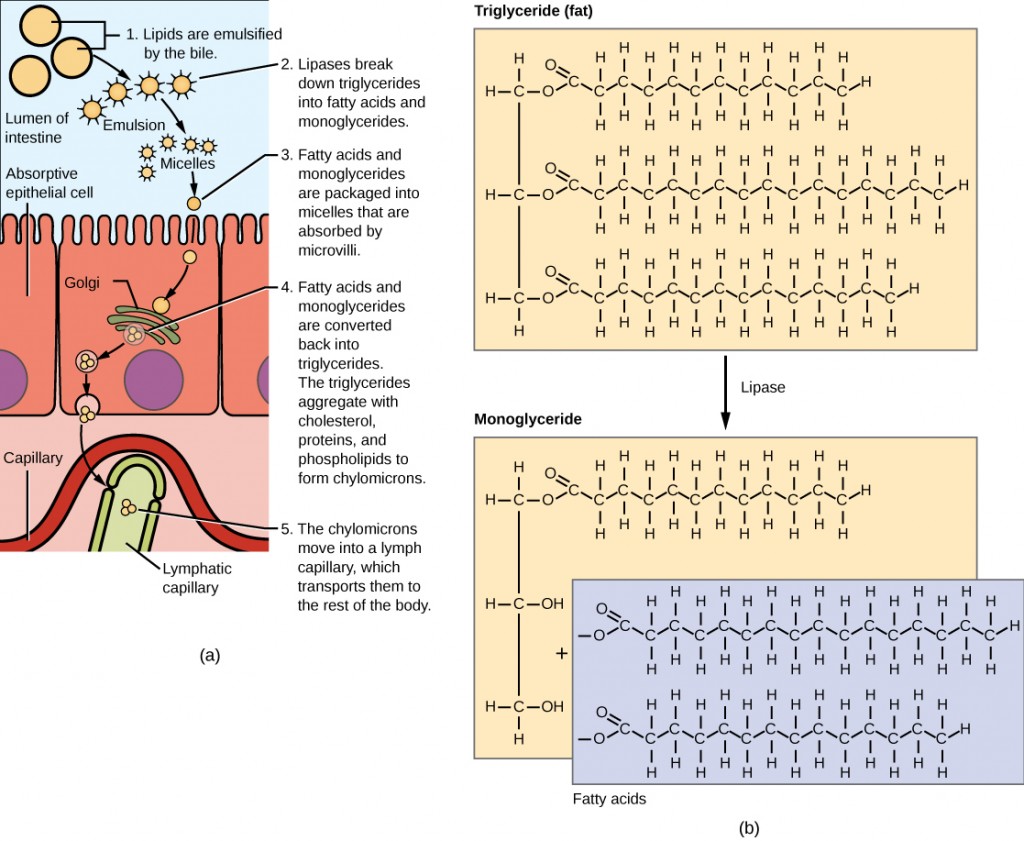
Lipids are digested and absorbed in the pocket-size intestine.
Vitamins
Vitamins can be either h2o-soluble or lipid-soluble. Fatty soluble vitamins are absorbed in the aforementioned manner as lipids. It is important to consume some amount of dietary lipid to assist the absorption of lipid-soluble vitamins. Water-soluble vitamins tin be directly absorbed into the bloodstream from the intestine.
Concept in Action

This website has an overview of the digestion of protein, fatty, and carbohydrates.
Which of the following statements about digestive processes is true?
- Amylase, maltase, and lactase in the mouth assimilate carbohydrates.
- Trypsin and lipase in the stomach digest protein.
- Bile emulsifies lipids in the modest intestine.
- No food is absorbed until the modest intestine.
Elimination
The terminal step in digestion is the elimination of undigested food content and waste material products. The undigested food material enters the colon, where well-nigh of the water is reabsorbed. Retrieve that the colon is also abode to the microflora chosen "intestinal flora" that aid in the digestion process. The semi-solid waste is moved through the colon by peristaltic movements of the muscle and is stored in the rectum. Every bit the rectum expands in response to storage of fecal matter, information technology triggers the neural signals required to set upward the urge to eliminate. The solid waste product is eliminated through the anus using peristaltic movements of the rectum.
Mutual Problems with Emptying
Diarrhea and constipation are some of the virtually common wellness concerns that impact digestion. Constipation is a condition where the feces are hardened because of backlog water removal in the colon. In dissimilarity, if enough water is not removed from the feces, it results in diarrhea. Many bacteria, including the ones that crusade cholera, affect the proteins involved in h2o reabsorption in the colon and effect in excessive diarrhea.
Emesis
Emesis, or airsickness, is elimination of food by forceful expulsion through the oral fissure. It is ofttimes in response to an irritant that affects the digestive tract, including only non limited to viruses, leaner, emotions, sights, and food poisoning. This forceful expulsion of the food is due to the potent contractions produced by the stomach muscles. The procedure of emesis is regulated by the medulla.
Summary
Animal diet should exist balanced and encounter the needs of the torso. Carbohydrates, proteins, and fats are the primary components of food. Some essential nutrients are required for cellular function only cannot be produced past the animate being trunk. These include vitamins, minerals, some fat acids, and some amino acids. Food intake in more than necessary amounts is stored as glycogen in the liver and musculus cells, and in fat cells. Excess adipose storage can pb to obesity and serious health problems. ATP is the energy currency of the cell and is obtained from the metabolic pathways. Excess carbohydrates and free energy are stored equally glycogen in the trunk.
Exercises
- Where does the majority of protein digestion accept place?
- stomach
- duodenum
- mouth
- jejunum
- Lipases are enzymes that suspension down ________.
- disaccharides
- lipids
- proteins
- cellulose
- Explain why some dietary lipid is a necessary role of a balanced nutrition.
Answers
- A
- B
- Lipids add flavour to nutrient and promote a sense of satiety or fullness. Fatty foods are sources of loftier energy; one gram of lipid contains ix calories. Lipids are also required in the diet to aid the absorption of lipid-soluble vitamins and for the production of lipid-soluble hormones.
Glossary
aminopeptidase: protease that breaks downward peptides to unmarried amino acids; secreted by the castor border of small intestine
anus: exit bespeak for waste material
bile: digestive juice produced by the liver; of import for digestion of lipids
bolus: mass of food resulting from chewing activeness and wetting by saliva
carboxypeptidase: protease that breaks down peptides to single amino acids; secreted by the castor border of the small-scale intestine
chylomicron: small lipid globule
chyme: mixture of partially digested food and tum juices
chymotrypsin: pancreatic protease
digestion: mechanical and chemical break downwards of food into small organic fragments
dipeptidase: protease that breaks downwardly peptides to single amino acids; secreted past the brush border of small intestine
duodenum: get-go function of the small-scale intestine where a large part of digestion of carbohydrates and fats occurs
elastase: pancreatic protease
esophagus: tubular organ that connects the mouth to the stomach
essential nutrient: nutrient that cannot exist synthesized by the body; it must exist obtained from nutrient
gallbladder: organ that stores and concentrates bile
ingestion: human activity of taking in food
jejunum: 2d part of the pocket-sized intestine
lactase: enzyme that breaks down lactose into glucose and galactose
large intestine: digestive organization organ that reabsorbs h2o from undigested fabric and processes waste matter
lipase: enzyme that chemically breaks downwardly lipids
liver: organ that produces bile for digestion and processes vitamins and lipids
maltase: enzyme that breaks down maltose into glucose
mineral: inorganic, elemental molecule that carries out important roles in the body
pancreas: gland that secretes digestive juices
pepsin: enzyme found in the tum whose main office is protein digestion
rectum: area of the body where feces is stored until elimination
small intestine: organ where digestion of poly peptide, fats, and carbohydrates is completed
stomach: sac-similar organ containing acidic digestive juices
sucrase: enzyme that breaks downward sucrose into glucose and fructose
trypsin: pancreatic protease that breaks down protein
vitamin: organic substance necessary in pocket-sized amounts to sustain life
Source: https://opentextbc.ca/biology/chapter/15-3-digestive-system-processes/
0 Response to "In Which Test Tube(S) Did Protein Digestion Occur (Activity 4)? How Do You Know?"
Post a Comment