What is the first valid host and mask on the subnet that the node 12.21.64.105/20 belongs to?
Subnetting can seem complicated, only with this subnet crook sheet yous should be well on your way to creating and managing subnets with ease. The subnetting tutorial below contains key tips for the process. After outlining what IP addresses are and how they work, we'll accept a expect at what subnetting is. I'll cover key components and processes such as subnet classes and subnet masking and organizing and managing subnets. All of the concepts in this subnetting guide are broken down into modest parts, to make this topic equally digestible every bit possible.
Table of Contents:
What Are Subnets Used For?
What Is an IP Address?
What Is an IP Class?
Subnet Mask Cheat Canvass: What Is Subnet Masking?
Using Subnets to Organize and Optimize Your Network
Subnetting Tutorial: Commonly Asked Questions
How Can Subnetting Be Managed More than Easily?
Best Subnetting Tool
What Are Subnets Used for?
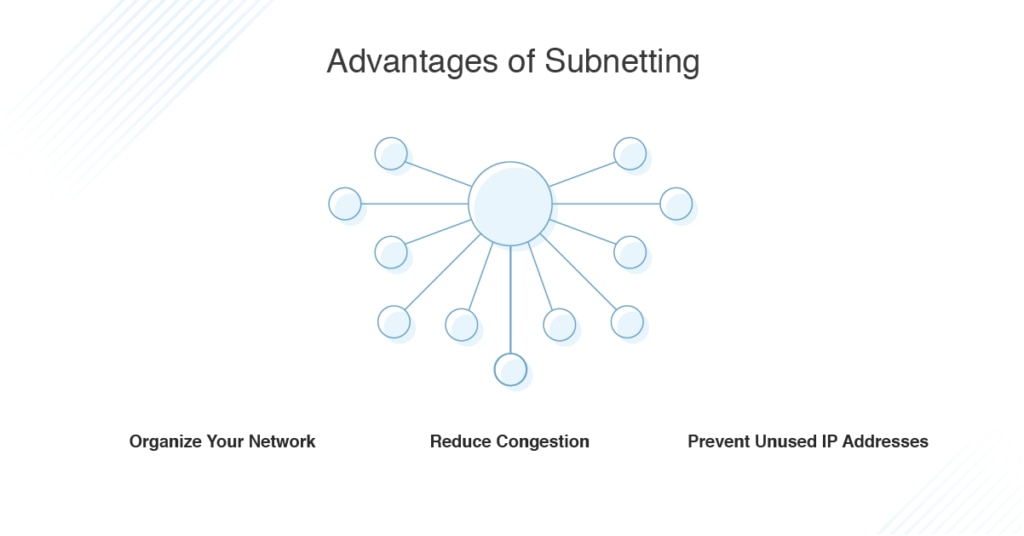
Subnets offer a mode of organizing your network to help to reduce network congestion. When yous have a lot of traffic flowing betwixt detail parts of your network, it can assistance to grouping those parts in a single section, so the traffic doesn't take to travel beyond the unabridged network to get from identify to place. Separating out pocket-size parts of your network into subnets allows traffic to flow more quickly and to avoid taking unnecessary routes, adding traffic where it isn't needed.
In addition, subnetting helps in efficiently allocating IP addresses and prevents large numbers of IP addresses from going unused. Subnets are usually fix geographically for particular offices, or for particular teams within a business to let their network traffic to stay within the location.
What Is an IP Address?
Before we can start to understand how subnets piece of work and how to manage them, it'southward important to take a strong grasp on how IP addresses piece of work. An IP address is essentially an identifier for whatsoever device connected to a network. There are two kinds of IP accost: IPv4 (version 4) and IPv6 (version 6). An example of an IPv4 accost is:
216.27.61.137
An IPv4 address uses 32 binary $.25 to limited the identifier of the device. To make the binary bits expression easier to understand, the 32 $.25 are dissever into four groups of 8, so each grouping is turned into a decimal number. These iv groups are separated by a dot, as you tin can run into in the example above.
IPv6 addresses are made upward of 128 binary bits. These bits are separated into eight groups, and each group is separated by a colon. An instance of an IPv6 address is:
2001:cdba:0000:0000:0000:0000:3257:9652
In normal use, the groups consisting entirely of the number zero are removed and replaced past a colon to shorten the IP address for ease of use.
IPv6 was created because 232 combinations were possible in IPv4, allowing up to 4.3 billion unique IP addresses. Every bit the cyberspace and number of devices grew, new combinations of numbers became necessary. IPv6 allows upward to ii,128 combinations, which has expanded the number of possible unique IP addresses significantly.
IP addresses can be shared with one other device, multicast to multiple other devices, or circulate to everyone—in other words, public. IP addresses can also be dynamic or static. A static IP address means a particular device has an IP accost assigned to it, which doesn't change. A dynamic IP address means when a device joins a network it's assigned an available IP accost, which could change each time the device connects.
Back to superlative
What Is an IP Class?
Now that nosotros've looked at what an IP address is, the next thing to consider is IP classes, as these are essential for understanding how subnets piece of work.
Say you're trying to discover one detail IP address, or organize IP addresses on your network. This would be an incommunicable chore without some kind of system. IP addresses are divided into numerical sections to assistance yous find what you're looking for more than quickly. These sections are chosen classes. IP addresses are divided into three classes: A, B, and C.
- Class A: IP addresses are those betwixt 0.0.0.0 and 127.255.255.255.
- Class B: IP addresses are those between 128.0.0.0 and 191.255.255.255.
- Class C: IP addresses are those between 192.0.0.0 and 223.255.255.255.
If you lot're trying to determine the class of an IP address, you lot need to expect at the showtime number. If the first number is i through 127, it'll be a class A address. If the first number is 128 through 191, it's a class B address. Finally, if it's 192 through 223, it'southward a class C address.
Depending on the IP address course, dissimilar portions of the IP accost are used to designate the network and the host. For example, class A only uses 8 bits of the IP address for the network, leaving 24 for the host. So, using the example 126.27.61.137, the network IP address would exist 126.0.0.0 and the host address would exist 0.27.61.137.
For a course C address, 24 bits are used for the network, and eight remain for the host. Using 200.23.65.1 as an example, this would result in 200.23.65.0 for the network and 0.0.0.x for the host.
For networks such as a TCP/IP network to role, the routers passing information throughout the network don't need to know the exact host address. They only need to know the network portion of the IP address; then, once the packet is delivered to the host's network, it tin go to the right host.
Subnet Mask Crook Sheet: What Is Subnet Masking?
Each IP address class has a matching "subnet mask," which is an easy way of identifying which part of the IP accost relates to the network and which part relates to the host. This is essential to ensure packets traveling through the network get to the right identify.
The default matching subnet masks for each subnet class are as follows:
- Class A:0.0.0
- Class B:255.0.0
- Class C:255.255.0
When we look at the subnet masks and catechumen the decimal numbers back into binary, we can see which $.25 of the IP address are allocated to the network and which are allocated to the host.
In binary, 255 is 11111111, and 0 is 0. So a subnet mask of 255.255.255.0 would be converted to:
11111111.11111111.11111111.0000000
When you match this with an IP address, such as 192.168.123.132, you can decide the network portion and the host portion of the IP accost. Each "1" in the subnet mask exists for the bit portions of the IP accost allocated to the network, and each "0" exists for when a bit portion is allocated to the host. Hither is an example:
11111111.11111111.11111111.0000000 (subnet mask)
11000000.10101000.01111011.10000100 (IP accost 192.168.123.132 in binary)
This means the network portion of the subnet is 192.168.123, and the .132 is allocated to the host. When information arrives on the 192.168.123.0 network, it'll exist candy as part of the network then delivered to the 0.0.0.132 host.
Back to top
Using Subnets to Organize and Optimize Your Network
Essentially, a subnet is a smaller portion of the network within class A, B, or C. Creating and using subnets can help to continue your network organized and functional.
Allow'due south suppose a concern wants to use four different IP address blocks for the different segments of its network, with 50 hosts per segment. The business organisation uses the post-obit IP address blocks:
200.1.0.0
200.1.1.0
200.one.2.0
200.i.three.0
Each IP accost cake can create 254 IP addresses, which allows 254 10 iv total IP addresses to be created for use in the network. This amounts to 1,016 IP addresses. But the business only wants 50 hosts on each block, then information technology'll have 816 IP addresses that don't get used at all. This is a waste of IP addresses that could be used past other devices. Subnetting is a mode to divide an IP address cake into smaller portions, so fewer IP addresses are wasted.
Nosotros know for the first IP address, 200.1.0.0, 200.1.0 is the network portion, and .0 is the host portion. The full IP address in the 32 binary bits would expect similar:
11001000.00000001.00000000.00000000
Only nosotros know we don't need all 254 hosts created past this IP address block, and then we tin borrow some of the host "bits" to create a new "subnetwork," or subnet.
Using the 11001000.00000001.00000000.00000000 example, we would infringe one "fleck" from the host portion to create a subnet.
Then:
11001000.00000001.00000000.00000000
would get:
11001000.00000001.00000000.10000000
As a result, the new decimal IP address would get:
200.one.0.128
Borrowing this one bit from the host portion of the IP address however leaves seven $.25 in the host portion. Seven bits in the host portion allow 128 IP addresses to be created, which is even so more than enough for the business's needs. If we follow through the procedure and borrow another bit from the host portion of the IP accost, iv subnets can exist created:
11001000.00000001.00000000.00000000 200.ane.0.0
11001000.00000001.00000000.01000000 200.1.0.64
11001000.00000001.00000000.10000000 200.1.0.128
11001000.00000001.00000000.xi000000 200.1.0.192
These four subnets allow 64 IP addresses to be created, and there's far less wastage than in the case above.
There are two hosts reserved for the IP addresses needed for the network identity itself (the first IP) and the broadcast address (the last IP). And so for each IP address cake, but 12 IP addresses are wasted.
This is where subnet masks come dorsum in. If you've "borrowed" bits from the host portion of the IP address, it can be hard to tell where the network portion ends and the host portion begins. With a subnet mask, you can specify which portions of the subnet are the network and which portions are the host.
For instance, for the IP address 200.ane.0.64 created above, the subnet mask would exist:
11111111.11111111.11111111.1100000 (subnet mask 255.255.255.192)
11001000.00000001.00000000.01000000 (IP address 200.1.0.64 in binary)
The "11" at the beginning of the terminal portion of the subnet mask, resulting in the "192" portion, shows the beginning two bits of the host portion of the IP address vest to the subnet, instead of the host.
Back to superlative
Subnetting Tutorial: Commonly Asked Questions
Building on this understanding of subnets and how they work, the following subnetting cheat sail will address how to navigate, understand, and manage them.
How Many Hosts Tin You lot Accept in Your Subnet?
Determining how many hosts y'all tin can have in your subnet is of import, every bit y'all don't want to stop up with a subnet too small-scale to host all the IP addresses you need, or one too large and resulting in a lot of wastage.
You can effigy out how many hosts yous can have in your subnet by subtracting the number of network bits from the number of full $.25: in other words, 32 total bits, minus the number of network $.25. Let'due south use 26 as an case.
A subnet with 26 network bits has six $.25 available for the host IP addresses. You then too demand to subtract 2 IP addresses for the network IP itself and the broadcast address.
So, the formula is as follows:
2^32-26 – 2 = 2^vi – 2 = 62
Y'all can use this with whatsoever number of network bits to determine how many bits you have available to create hosts for your subnet.
How Do Y'all Know What Subnet an Address Is On?
You also might desire to chop-chop determine the subnet a given IP address is a part of.
Let's look at the IP address 156.67.154.75/28. First, you lot demand to determine how many of the $.25 are allocated to the network and how many to the host. We already know, in this IP address, 28 are used for the network and four are for the host.
Then, yous need to make up one's mind how big the subnet is, by taking the number of $.25 allocated to the host, and raising 2two to the ability of that number. In the above case this is 2^4, or 16. This is chosen the "cake size," because it refers to the size of the subnet blocks into which the network has been divided. You lot can use this cake size to count upward from zero to determine which subnet block the IP address belongs to.
For 156.67.154.75, y'all would start at 156.67.154.0 and go upwards by sixteen at a time, as follows:
156.67.154.0/28
156.67.154.16/28
156.67.154.32/28
156.67.154.48/28
When counting further upwardly, you can come across 156.67.154.75 falls in between the two subnet blocks:
156.67.154.64/28
156.67.154.eighty/28
This ways the 156.67.154.75 IP address is in the subnet beginning with 156.67.154.64, because .80 would be too loftier.
This tin take a bit of practice. Just remember to first determine the number of $.25 in the IP address allocated to the hosts, then take the number 2 and enhance it past the number of bits allocated to hosts. Whatever number you go is the block size, and you can then count up within the IP address past the block size, until you find two blocks the IP address falls between. The IP address is in the lower subnet of those two blocks.
How Do You Make up one's mind Whether Two Addresses Are in the Same Subnet?
Yous may want to figure out whether ii addresses are in the same subnet. The first step in doing so entails determining the size of the subnet cake. And so, you summate the valid host range to come across if the second address falls within the same range.
Hither's an example of this process, using the post-obit ii IP addresses:
10.21.45.137/13
x.23.156.198/xiii
You can see the number of network $.25 is thirteen, which means the subnet must be fix in the 2d octet, or the second part of the IP address.
And so, we can brainstorm with the IP address 10.0.0.0/thirteen.
We can also determine the subnet cake size, by taking the number of $.25 allocated to the host and raising two to the ability of that number. So, with a maximum of xvi bits in the first two octets, the subnet cake size is ii^(16-13) = 8.
You can then work through the subnet blocks, increasing by eight at a time:
10.0.0.0/13
10.8.0.0/13
ten.16.0.0/thirteen
10.24.0.0/thirteen
Since 10.21.45.137/thirteen and 10.23.156.198/13 are both between 10.xvi.0.0/thirteen and 10.24.0.0/xiii, they are both on the same subnet.
Back to summit
How Can Subnetting Be Managed More Easily?
One way to simplify the process of managing your subnets is by using a tool. My recommendation is SolarWinds® IP Address Manager (IPAM), which has several features to automate and streamline this process.
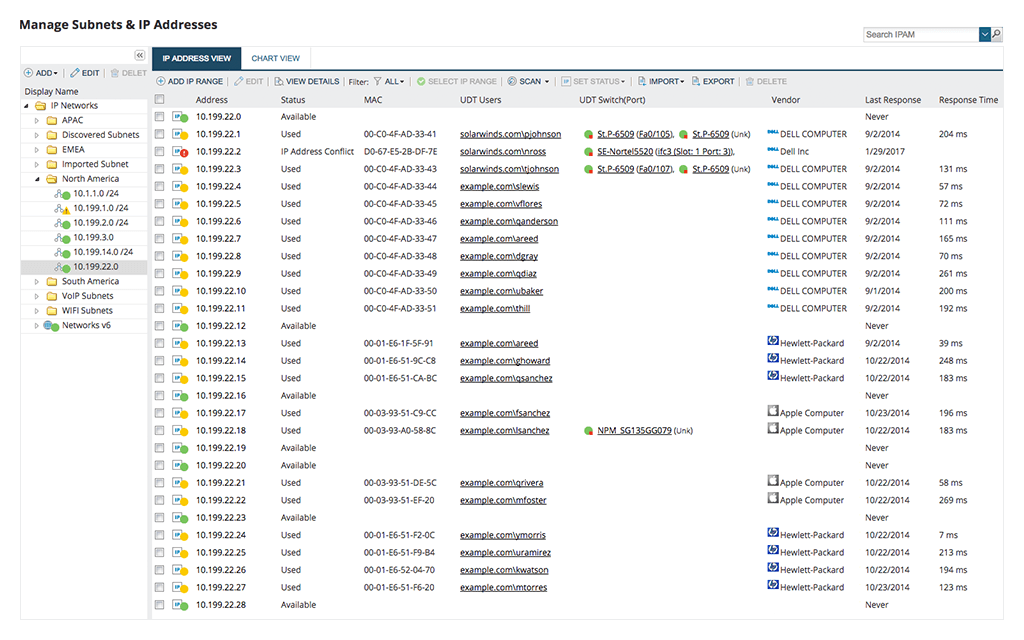
IPAM includes an automated subnet discovery wizard assuasive you to discover and collect information on all of your subnets, showing yous which IP addresses are part of each ane. If you have all of your subnet and IP address information in spreadsheets, IPAM tin easily import these.
Information technology as well includes a subnet resource allotment wizard, which looks at the traffic and size of your network, and then optimizes your IP addresses into subnets suiting your needs. The interface allows yous to group and organize your subnets and IP addresses in a way that makes it like shooting fish in a barrel to observe the information you need.
For creating subnets, IPAM gives you the power to simply select a network, group, or supernet you want to subnet. Through an easy-to-use interface, you can choose to name the subnet, give it an accost, and give it custom properties if you want. This simplifies the subnetting creation procedure and helps you to customize and organize your subnets from the outset.
SolarWinds IPAM includes a dashboard showing you lot the scope of your IP subnet and its utilization and can create alerts to let you know when a subnet is getting full or when you lot take a subnet with a huge corporeality of unused infinite. Using the IP address view, network view, or chart view, you can gain unlike perspectives on how your network is functioning and how your IP addresses are allocated. This tin help you to optimize your subnets and reduce IP accost wastage.
I hope my IP subnet cheat canvass has given yous a greater agreement of subnetting. This subnetting guide has covered how subnets piece of work, the core concepts backside them, and the basics of subnetting. It has too answered some key questions about issues with subnets and looked at how tools can help you lot to manage your subnets more hands. My recommended tool for this purpose is SolarWinds IP Address Manager, a robust software enabling y'all to allocate IP addresses into subnets, and monitor and manage them, with efficiency. A xxx-day gratuitous trial lets you endeavour the fully functional plan without chance.
Source: https://www.dnsstuff.com/subnet-ip-subnetting-guide
0 Response to "What is the first valid host and mask on the subnet that the node 12.21.64.105/20 belongs to?"
Post a Comment